


Pine trees across Louisiana’s Northshore face a serious threat that many property owners don’t recognize until it’s too late. Southern Pine Beetle ranks as one of the most destructive forest pests in the southeastern United States, and these tiny insects have been particularly active this year due to ongoing drought conditions affecting Covington, Mandeville, and Madisonville.
Understanding how these beetles operate, what signs to look for, and when to take action can mean the difference between saving your pine trees and watching them die within weeks. More importantly, knowing how to prevent infestations protects your landscape investment and keeps your property safe from hazardous dead trees.
What Is Southern Pine Beetle?
Southern Pine Beetle might be small, only about one eighth of an inch long, but it causes massive damage across Louisiana and the entire Southeast. These reddish brown to black insects burrow beneath pine bark, where they feed, reproduce, and introduce a deadly fungus that kills trees faster than the beetles themselves.
What makes these pests so dangerous is their ability to reproduce quickly and attack trees in overwhelming numbers. A single female beetle can produce multiple generations in one year when conditions are right. During warm weather, the complete life cycle from egg to adult takes just 30 to 40 days, which means populations explode rapidly during summer months.
The beetles target stressed or weakened pine trees first, but once their populations build up, they’ll attack healthy trees too. Loblolly pines, Slash pines, and shortleaf pines are their preferred hosts, all of which grow throughout the Northshore region. When an outbreak occurs, these insects can wipe out entire stands of pine trees in residential areas within a matter of weeks.
Unlike many other tree pests that cause gradual decline, Southern Pine Beetle infestations work fast. Trees can go from appearing healthy to completely dead in just two to three weeks during peak summer activity. That rapid timeline leaves little room for error when it comes to detection and response.
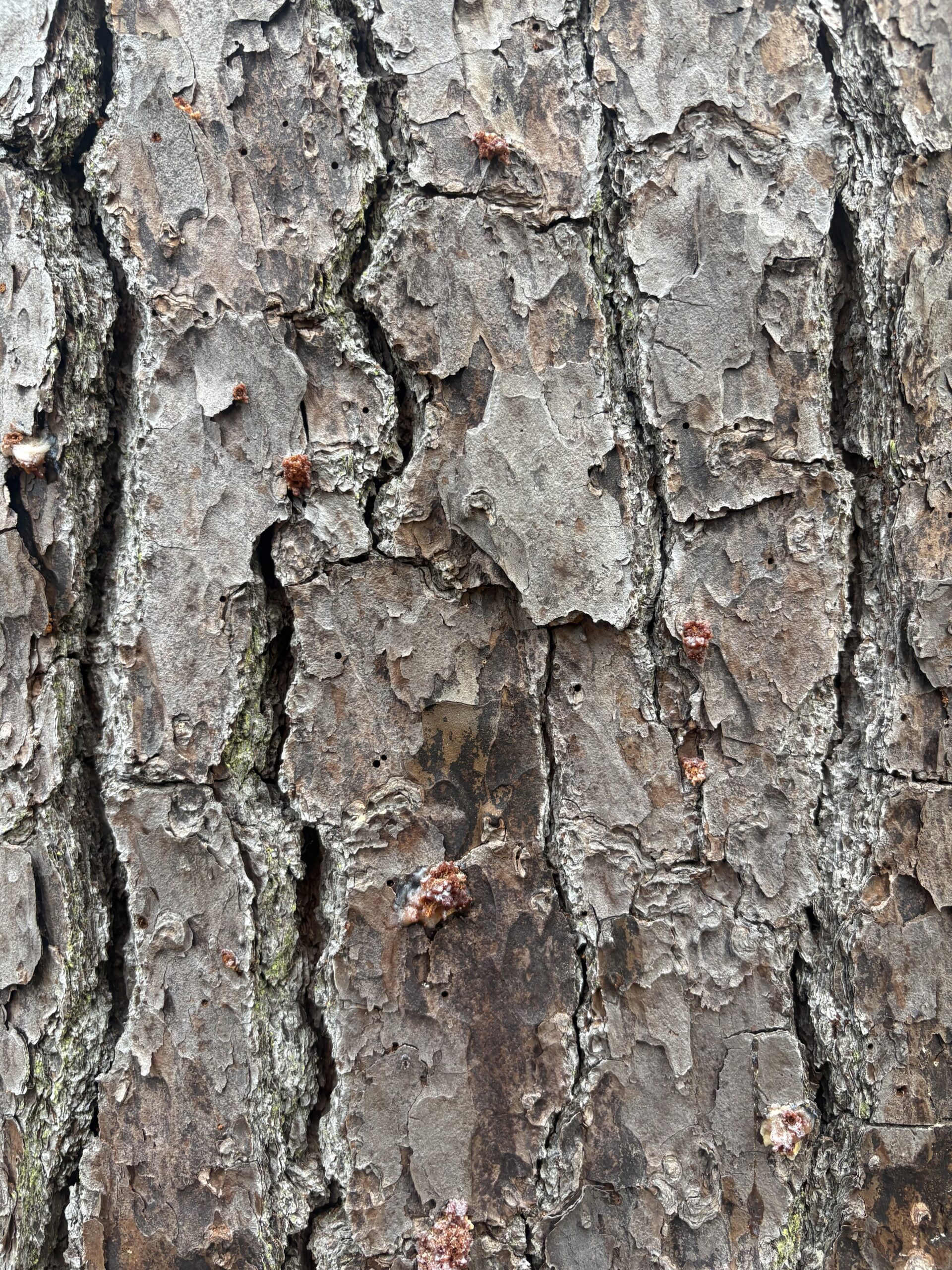
Pine Beetle Damage: The bumps you’re seeing on the tree are called pitch tubes. They form when the tree forces out sap at the beetle’s entry points in an effort to push the invading beetles back out.
How to Identify Southern Pine Beetle Infestations on Your Property
Catching a beetle problem early gives you the best chance of limiting damage to your property. Unfortunately, most people don’t notice anything wrong until pine needles start turning brown, and by that point, the tree is already dead and beetles have likely moved on to attack neighboring pines.
Watch for small white/orange pitch tubes on the bark. When Southern Pine Beetle adults bore into a tree, the pine tries to defend itself by pushing out resin. This creates small, popcorn sized masses on the bark surface, typically white, orange or cream colored. You’ll find these pitch tubes in bark crevices at any height on the trunk, not just near the base. The presence of fresh, wet pitch tubes means beetles are actively attacking the tree right now.
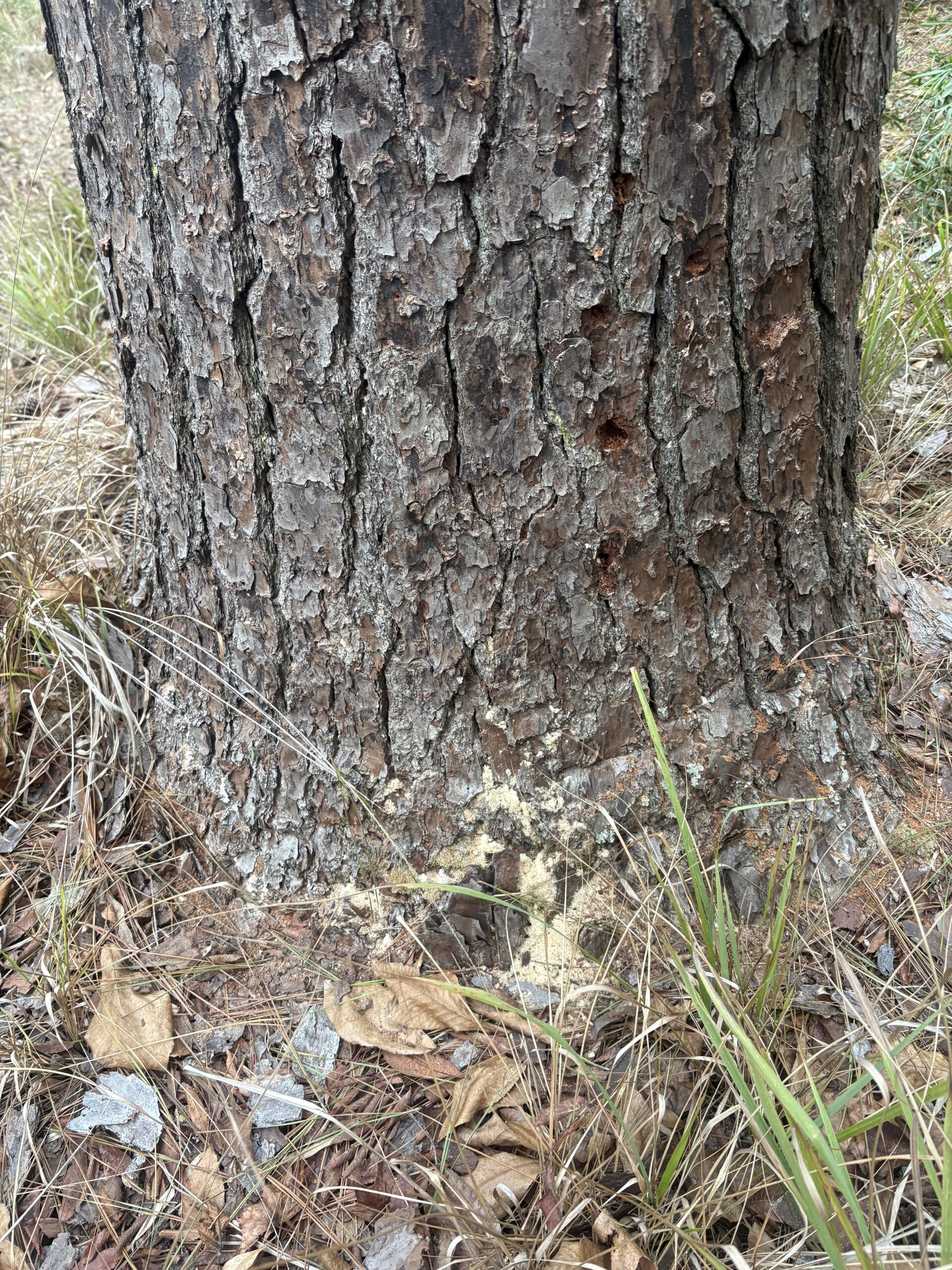
Look for boring dust in bark crevices. As beetles tunnel through bark, they push out fine, reddish brown sawdust that accumulates in bark crevices and around the tree’s base. This boring dust, combined with pitch tubes, confirms an active infestation. The sawdust might appear wet or clumped together if the tree is still producing resin in response to the attack.
Notice when needles start changing color. Healthy pine needles are deep green. When beetles introduce blue stain fungus into a tree, the needles begin fading to pale green, then yellow, and finally reddish brown. This color change moves through the crown over several weeks. By the time needles turn completely brown, the tree has been dead for a month or more, and beetles have already emerged to attack other trees.
Pay attention to increased woodpecker activity. Woodpeckers feed on beetle larvae under the bark, so they often detect infestations before visible symptoms appear. If you notice woodpeckers suddenly showing intense interest in a pine tree, check for other signs of beetle activity. The birds will peck away bark to reach the larvae underneath, creating additional damage patterns on the trunk.
Check for small exit holes in the bark. After completing their life cycle under the bark, adult beetles chew tiny holes to emerge. These exit holes are about the size of a pinhead and appear in large numbers across affected bark. Seeing these holes means beetles have already left the tree to find new hosts. The presence of exit holes tells you that the next generation of beetles is now attacking nearby pines.
If you peel back a section of loose bark on an infested tree, you’ll see distinctive winding galleries that look like the letter “S” carved into the wood surface. These serpentine tunnels are where female beetles laid eggs and larvae fed as they grew. The galleries appear packed with a mixture of sawdust and insect waste called frass.
Why Pine Trees Become Vulnerable to Bark Beetle Attacks
Healthy, vigorous pine trees can usually defend themselves against small numbers of attacking beetles. They produce copious amounts of sticky resin that physically pushes insects out of the tree and contains chemicals toxic to beetles. However, when trees become stressed or weakened, their natural defenses break down, making them prime targets for Southern Pine Beetle infestations.
Drought stress is the leading factor. When soil moisture drops too low for too long, pine trees shut down non-essential functions to conserve energy and water. Resin production is one of the first things to slow down. This year’s extended dry conditions across the Northshore have weakened countless pine trees, leaving them unable to fight off beetle attacks. Trees need consistent moisture to maintain the vigor necessary for pest resistance.
Overcrowding creates competition. When too many pine trees grow too close together, they compete for limited water, nutrients, and sunlight. None of the trees can develop strong, extensive root systems or maintain full, healthy crowns. This chronic stress makes every tree in an overcrowded stand more susceptible to beetles. Thinning out excess trees improves the health and resilience of the remaining pines.
Root damage compromises tree health. Construction activities, trenching for utilities, soil compaction from heavy equipment, and even excessive foot traffic can damage pine roots. Since roots are responsible for taking up water and nutrients, any damage affects the entire tree. Even construction that occurs 20 or 30 feet away from a tree can impact enough roots to stress it severely. The trees might look fine above ground, but they’re struggling below the surface.
Lightning strikes attract beetles from miles away. Summer thunderstorms are common across the Northshore, and lightning struck pines send out chemical distress signals that attract bark beetles. These severely damaged trees can’t defend themselves at all and become breeding grounds where beetle populations build up before spreading to nearby healthy trees. Lightning damage weakens the tree’s ability to produce protective resin, making it an easy target.
Mechanical wounds create entry points. Damage to the trunk from lawnmowers, string trimmers, vehicles, or construction equipment creates wounds that weaken the tree and make it more attractive to beetles. Fresh wounds also provide easy entry points where beetles don’t have to work as hard to penetrate the bark. Any time you damage the bark on a pine tree, you’re potentially inviting pest problems.
Poor site conditions limit tree growth. Many areas around Covington, Mandeville, and Madisonville have heavy clay soils that don’t drain well, leading to alternating periods of waterlogging and drought. These challenging soil conditions prevent pines from developing the robust health they need to resist pest attacks. Trees planted in the wrong location or in unsuitable soil never reach their full defensive potential.
The Connection Between Southern Pine Beetle and Blue Stain Fungus
Here’s what makes Southern Pine Beetle so deadly: the insects don’t just feed on trees, they also introduce a fungus that does as much damage as the beetles themselves. This blue stain fungus gets its name from the blue gray discoloration it creates in pine wood.
Female beetles carry fungal spores in specialized structures on their bodies. When they bore into a tree to lay eggs, they inoculate the wood with these spores. The fungus grows rapidly through the tree’s water conducting tissue, called xylem, blocking the flow of water from roots to needles.
Even if you could kill every beetle in a tree with insecticide, the blue stain fungus continues spreading and eventually kills the tree anyway. That’s why insecticides don’t work on trees already infested with Southern Pine Beetle, the fungal infection is a death sentence regardless of whether the beetles survive.
The fungus spreads through the tree faster than the beetle galleries themselves. Within days of initial attack, fungal growth begins blocking water transport. Within a week or two, enough tissue becomes clogged that the tree can’t move water to its crown. That’s when needles start changing color, signaling that the tree is dying.
This relationship between beetle and fungus is called a symbiotic relationship. The fungus benefits because beetles carry it to new host trees. The beetles benefit because the fungus weakens the tree’s defenses and makes the wood easier for beetle larvae to feed on. Unfortunately for pine trees, this partnership is devastatingly effective at killing them quickly.
Understanding Ips Beetles and Black Turpentine Beetles
While Southern Pine Beetle causes the most widespread damage, two other bark beetle species also attack pines in our area. Knowing the differences between these insects helps determine the right management approach.
Ips beetles usually attack individual trees or small groups. There are actually three species of Ips beetles in Louisiana, but distinguishing between them isn’t necessary for management purposes. These beetles range from one eighth to one quarter inch long and have distinctive spines on their rear ends, though you need a magnifying glass to see this feature clearly.
Ips beetles create straight, linear galleries under the bark that look like the letters Y or H. Their pitch tubes tend to be pinkish and appear directly on bark plates rather than in crevices. Some Ips species prefer attacking the upper portions of trees, which makes detection from the ground difficult. Like Southern Pine Beetle, Ips beetles also introduce blue stain fungus, so infected trees can’t be saved with insecticides. The good news is that Ips beetles typically don’t spread as rapidly through a stand of trees as their more aggressive cousins do.
Black turpentine beetles are the largest of the three species. These robust, black beetles measure one quarter to three eighths of an inch long. They almost exclusively attack the lower ten feet of the trunk, and their pitch tubes can be as large as a silver dollar, much bigger than those created by other bark beetles. These large pitch tubes are usually the first sign of a black turpentine beetle problem.
What sets black turpentine beetles apart is that they don’t carry blue stain fungus. Trees attacked by these beetles sometimes survive, especially if the infestation is light. Their galleries can be up to an inch wide and twelve inches long, extending downward from entrance holes in a fan shaped pattern. The beetles create these wider galleries because of their larger body size compared to Southern Pine Beetle.
Black turpentine beetles are particularly attracted to fresh pine resin, which makes them common on lightning struck trees, recently pruned pines, and fresh stumps from tree removal. While less destructive than Southern Pine Beetle, they still pose a threat to stressed trees and can kill pines if the infestation becomes heavy enough to girdle the trunk.
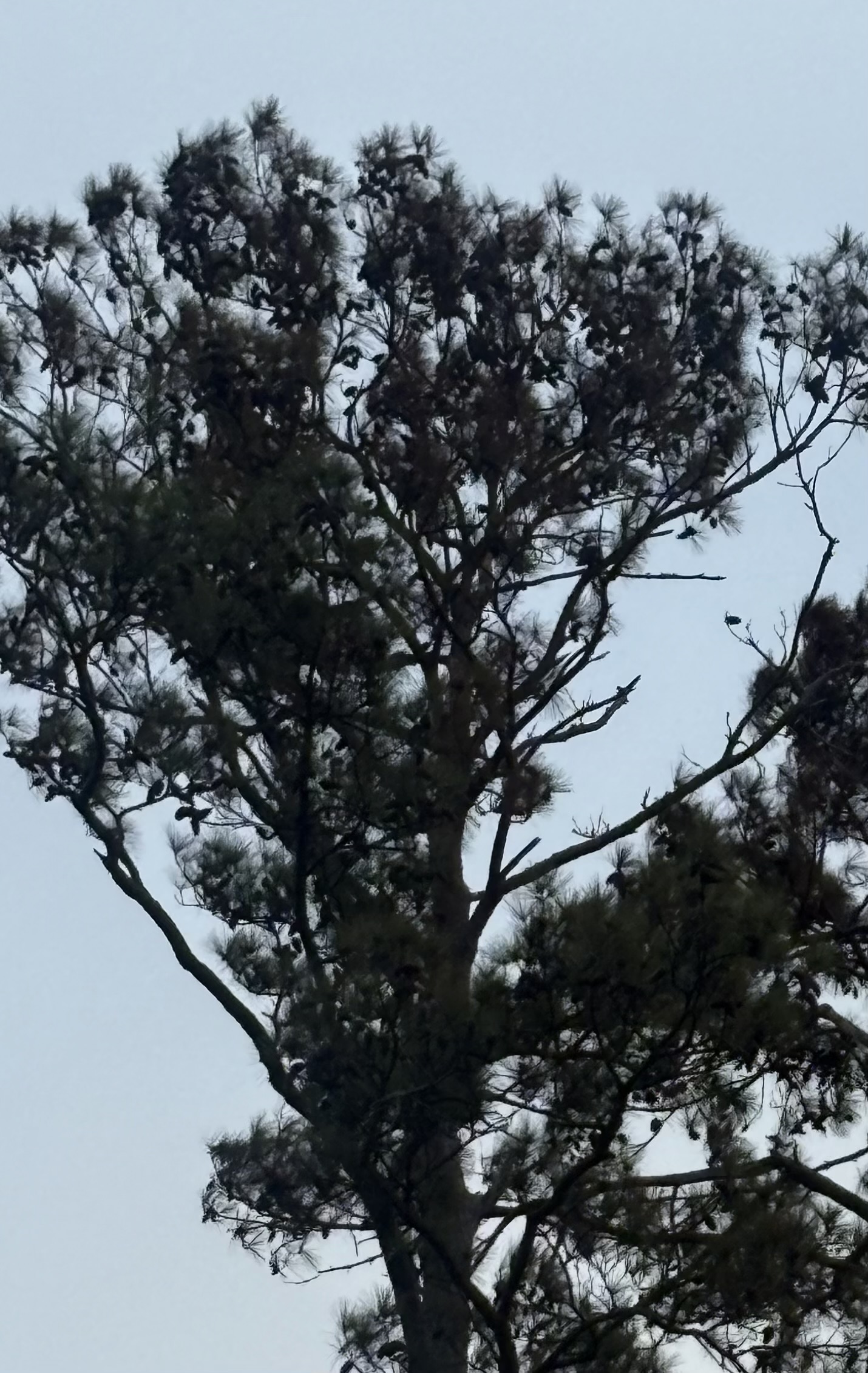
This photo shows significant canopy browning, a common sign of advanced pine beetle infestation. As the beetles disrupt the tree’s ability to move water and nutrients, the needles begin to fade and brown from the top down.
How Southern Pine Beetle Infestations Spread Through Your Property
Understanding how these beetles move from tree to tree explains why quick action is so important. When adult Southern Pine Beetle insects emerge from an infested tree, they don’t just randomly fly around looking for new hosts. They follow a pattern that allows outbreaks to spread predictably through a stand of pines.
Beetles spread to adjacent trees first. New adults emerging from an infested tree typically fly to the nearest suitable pine trees. This creates a classic “spot” pattern where infestations expand outward from the initial focus tree. Without intervention, a small group of infested trees can expand to encompass dozens or even hundreds of pines over the course of a summer. You’ll often see a circular or oval pattern of dead and dying trees spreading outward from where the infestation started.
Pheromones coordinate mass attacks. When the first few beetles successfully attack a tree, they release pheromones, chemical signals that attract more beetles to the same tree. This mass attack strategy overwhelms the tree’s resin defenses through sheer numbers. Thousands of beetles might attack a single tree simultaneously, making it impossible for even a healthy tree to produce enough resin to push them all out. This coordinated assault is what makes Southern Pine Beetle so effective at killing trees.
Warm weather accelerates reproduction. During hot summer months, Southern Pine Beetle can complete its life cycle in just 30 to 40 days. That means multiple generations can emerge and attack new trees within a single season. Cool weather slows development and reduces beetle activity, which is why infestations typically slow down in fall and winter. However, this year’s mild temperatures have allowed beetles to stay active much later than normal.
Drought conditions increase spread rates. This year’s extended dry period has created perfect conditions for rapid beetle spread. Stressed trees can’t defend themselves, so attacking beetles succeed more often and kill trees faster. That allows populations to build up quickly and attack more trees in a shorter timeframe. The combination of drought stress and active beetle populations creates a situation where infestations can explode across properties in the Covington, Mandeville, and Madisonville areas.
Wind and weather influence dispersal. While most beetles fly to nearby trees, some get carried longer distances by wind. Prevailing wind direction often influences which way an infestation spot expands. Strong winds during peak beetle flight periods can spread infestations to pines hundreds of feet away from the initial focus. This means that even if your nearest neighbor’s trees are several hundred feet away, beetles from their property can still reach your pines.
Why Drought Makes Southern Pine Beetle More Dangerous
The lack of rainfall can create a perfect storm for bark beetle problems. When you combine stressed trees with warm temperatures extending into late fall, beetle populations stay active well beyond their normal season.
Pine trees prioritize survival over defense during drought. When soil moisture drops, trees close the pores in their needles to reduce water loss. They also reduce or stop producing resin, which requires significant energy and water. Without adequate resin production, even healthy looking trees become easy targets for Southern Pine Beetle attacks. The trees are essentially defenseless against incoming beetle populations.
Extended warm weather keeps beetles active longer. Typically, beetle activity slows down in October and November as temperatures cool. Mild fall weather can allow beetles to continue reproducing into December. That means trees face attack pressure for several additional months beyond the normal danger period. Property owners who thought they were safe once fall arrived are now dealing with continued beetle activity.
Competition for water weakens all trees. In densely planted pine stands, drought stress affects every tree. When beetles attack one tree, the adjacent trees are also stressed and vulnerable. This allows infestations to spread faster than they would under normal moisture conditions. Every tree in an overcrowded stand is fighting for the same limited water supply, which means none of them can mount an effective defense.
Recovery takes time even after rains return. When drought finally breaks, trees don’t immediately regain their defensive capabilities. It takes weeks or months of adequate moisture for pines to rebuild their resin production systems and return to full vigor. During this recovery period, trees remain vulnerable to beetle attacks. Even after we get good rainfall, property owners need to stay vigilant for signs of infestation.
According to the National Park Service, Southern Pine Beetle has destroyed more timber than wildfires throughout the southeastern United States. These insects represent a constant threat to both commercial forests and residential landscapes across Louisiana.
Prevention Strategies for Protecting Your Pine Trees
Preventing beetle infestations beats trying to control them after they start. Once Southern Pine Beetle successfully attacks a tree and introduces blue stain fungus, nothing can save it. That makes prevention the only reliable strategy for protecting your landscape pines.
Keep trees properly watered during dry periods. Supplemental irrigation during drought helps maintain tree vigor and resin production. Deep watering once or twice weekly works better than frequent shallow watering. The goal is to keep soil moist down to 12 to 18 inches deep throughout the tree’s root zone. This is particularly important during extended dry spells like we’ve experienced this year across the Northshore.
Maintain mulch around pine trees. A three to four inch layer of wood chips or pine straw helps retain soil moisture, moderates soil temperature, and improves overall tree health. Mulch also protects roots from mechanical damage and reduces competition from grass and weeds. Keep mulch pulled back a few inches from the trunk to prevent moisture buildup against the bark. Proper mulching makes a real difference in how well trees handle stress.
Consider preventative trunk injection treatments. Trunk injection with emamectin benzoate provides effective protection against Southern Pine Beetle attacks on high value trees. This systemic insecticide gets absorbed into the tree’s vascular system, protecting it from beetle colonization for up to two years. The treatment works best when applied to healthy trees before beetle activity begins in your area. Trunk injections are particularly valuable for protecting specimen trees, trees in high risk areas, or pines that can’t easily be replaced. ArborWorks offers this preventative treatment as part of our comprehensive tree health management services.
Thin overcrowded pine stands. When too many trees compete for limited resources, all of them suffer. Thinning removes excess trees and allows remaining pines to develop stronger root systems and healthier crowns. This becomes especially important during drought years when water is already scarce. Professional guidance helps determine which trees to remove and which to keep for the best long term results.
Avoid damaging tree trunks and roots. Wounds from lawnmowers, string trimmers, and construction equipment stress trees and make them more attractive to bark beetles. Create mulch beds around pine trees to keep mowing equipment away from trunks. During construction projects, establish protective barriers well beyond the tree’s drip line to prevent root damage. Every wound you prevent is one less entry point for beetles.
Remove lightning struck pines immediately. These severely damaged trees can’t defend themselves and attract beetles from considerable distances. Getting them removed quickly, ideally within a few days of the lightning strike, prevents Southern Pine Beetle populations from building up and spreading to healthy nearby trees. Lightning damage sends out chemical signals that beetles can detect from miles away.
Time pruning carefully. Avoid pruning pine trees between March and October when beetles are most active. The wounds created by pruning release resin odors that attract bark beetles. If you must prune during this period, have the work done by professionals who can complete it quickly and apply protective treatments if necessary. Winter pruning between November and February is safest and doesn’t attract beetle attention.
Monitor trees regularly for early warning signs. Walk your property every few weeks during warm months and look for pitch tubes, boring dust, woodpecker damage, and changes in needle color. Catching an infestation in its earliest stages gives you the best chance of limiting spread to other trees. Regular monitoring costs nothing but your time and can save you thousands of dollars in tree removal costs.
What to Do When You Discover an Infestation on Your Property
Time matters when dealing with Southern Pine Beetle. A tree showing early symptoms today might be dead in two weeks, and dozens of adult beetles will emerge to attack neighboring pines. Quick action limits damage and protects the rest of your landscape.
Get professional identification first. Different bark beetles require different management approaches. Misidentifying the pest leads to inappropriate treatments that waste money and fail to solve the problem. Professional arborists can distinguish between Southern Pine Beetle, Ips beetles, and black turpentine beetles based on pitch tube characteristics, gallery patterns, and insect features. They’ll also determine whether an infestation is still active or has already run its course.
Remove infested trees immediately when needles start fading. Once needles begin turning pale green or yellow, the tree is dying and can’t be saved. These trees need to come down right away, before adult beetles emerge to attack healthy pines nearby. Don’t wait for needles to turn completely red, because by that point, beetles have already moved on to new hosts. Professional tree removal ensures the work gets done safely and quickly without putting people or property at risk.
Consider removing a buffer zone around infested trees. For active Southern Pine Beetle outbreaks, removing a 50 to 100 foot buffer of trees in the direction the infestation is spreading helps stop beetle spread. This aggressive approach makes sense when dealing with valuable pine stands or when numerous trees are at risk. An arborist can assess which trees to remove and which to monitor based on the specific situation on your property.
Dispose of infested material properly. Simply cutting down beetle killed trees and leaving them on site doesn’t solve anything. Adult beetles will continue emerging and attacking nearby pines. Infested wood should either be chipped on site and used as mulch in non pine areas, or hauled away entirely. Don’t store beetle infested logs for firewood unless they’re treated with insecticide first. Proper disposal breaks the reproduction cycle and prevents further spread.
Monitor surrounding trees closely. After removing infested trees, check nearby pines weekly for new pitch tubes or other signs of attack. Early detection of new infestations allows for quick response before problems escalate. Keep watching your remaining pines for at least a full growing season after removing infested trees to make sure the problem doesn’t come back.
Black turpentine beetle infestations allow for different options. Since these beetles don’t carry blue stain fungus and attack only the lower trunk, some trees survive without intervention. For active black turpentine beetle problems, insecticide sprays applied to the lower ten feet of trunk can control emerging adults and protect surrounding trees. This is the only bark beetle situation where insecticides provide useful results.
The Importance of Professional Tree Health Inspections
Many property owners don’t realize they have a beetle problem until extensive damage has occurred. By the time symptoms become obvious, multiple trees might be infested and the opportunity for early intervention has passed. Regular professional inspections catch problems early and identify risk factors before they lead to tree loss.
Certified arborists recognize subtle warning signs. Fresh pitch tubes, boring dust accumulations, and slight changes in needle color might go unnoticed by property owners but stand out clearly to trained professionals. Early detection makes a huge difference in limiting tree loss and preventing widespread outbreaks. Our team has seen thousands of infested trees and knows exactly what to look for at every stage of beetle activity.
Comprehensive inspections identify stress factors. Beyond checking for active beetle infestations, professional tree health inspections evaluate overall tree condition and identify issues that make pines vulnerable to attack. Root damage, overcrowding, soil problems, and environmental stress all show up during thorough evaluations. Addressing these underlying issues prevents future beetle problems from developing.
Professional guidance prevents costly mistakes. Knowing when to remove a tree, when to monitor it, and when to take preventative action requires experience and training. Making the wrong decision can lead to unnecessary tree removal or, worse, allow an infestation to spread unchecked. Professional recommendations help you make informed choices about your landscape that save money and protect your remaining trees.
Documentation supports insurance claims. If beetle damage becomes extensive, having professional inspection reports and photographs can support insurance claims for tree loss. Proper documentation shows that you took reasonable steps to address the problem and that damage resulted from natural causes beyond your control. This paperwork can make the difference between a successful claim and a denied one.
Regular monitoring catches new problems quickly. An initial inspection might find no active beetle problems, but conditions change. Follow up inspections during high risk periods ensure that new infestations get detected and addressed before they cause major damage. Ongoing monitoring provides peace of mind and protects your property investment.
How Storm Preparation Relates to Bark Beetle Management
Dead and dying pine trees create serious safety hazards during tropical weather events. A Southern Pine Beetle killed pine might look structurally sound from the outside, but the wood deteriorates rapidly once the tree dies. These compromised trees can snap or uproot with far less wind force than healthy pines can withstand.
Include tree health assessment in storm preparation. When evaluating your property for hurricane and tropical storm risks, don’t just look at tree structure, consider overall health too. Pine trees killed by bark beetles become increasingly hazardous as time passes. The wood dries out, decay fungi move in, and structural integrity declines steadily. These trees should be identified and removed as part of storm prep and risk mitigation efforts.
Dead pines near structures or power lines require immediate attention. If a beetle killed pine stands close enough to hit your house, your neighbor’s property, or utility lines when it falls, remove it without delay. The risk of catastrophic failure increases every time wind speeds pick up. Waiting for a named storm to approach leaves you scrambling to find tree services when everyone else is trying to do the same thing.
Proper tree care reduces storm damage risks. Regular tree trimming improves air circulation through pine canopies and removes dead wood that can break loose during high winds. Healthy, well maintained trees withstand storm forces better than stressed, neglected ones. That makes routine tree care part of long term storm preparedness for Northshore properties.
Beetle killed trees affect insurance coverage. Some insurance policies have specific provisions about hazard trees. If you know a dead tree poses a risk to structures and don’t remove it, your insurance company might deny claims for damage it causes. Maintaining documentation of tree inspections and removal work protects you from potential coverage disputes down the road.
Common Questions About Southern Pine Beetle Management
- Can I spray my healthy trees with insecticide to prevent beetle attacks? Preventative trunk spraying doesn’t work for Southern Pine Beetle or Ips beetles. These insects attack the entire trunk, not just the lower portions, making thorough surface coverage impossible. The blue stain fungus they introduce kills trees regardless of whether beetles survive. However, preventative trunk injection treatments with emamectin benzoate are highly effective at protecting healthy trees from beetle attacks. This systemic treatment gets absorbed into the tree’s vascular system and provides protection for up to two years. The only beetle species that responds to topical insecticide treatment is the black turpentine beetle, which attacks only the lower ten feet of trunk and doesn’t carry fungal pathogens.
- Will beetle killed trees attract termites to my house? Dead pine trees do attract wood boring insects as they decay, but these are typically beetles and other insects that feed only on dead wood. They don’t pose a threat to your home’s structure. However, leaving dead trees standing near your house creates other problems, including falling hazards and increased fire risk. Remove dead pines promptly rather than leaving them to decay naturally on your property.
- Can I save money by cutting infested trees myself? Removing beetle infested pines involves significant safety risks. These trees often have compromised structural integrity, making them unpredictable during felling. They might break unexpectedly, fall in unintended directions, or split up the trunk. Professional tree services have the equipment, training, and insurance necessary to handle dangerous removals safely. The money you might save isn’t worth the risk of serious injury or property damage.
- How do I know if my neighbors’ trees are infesting mine? Pine bark beetles don’t respect property lines. If trees on adjacent properties have active infestations, your pines face increased risk of attack. Look for the same warning signs, pitch tubes, boring dust, and fading needles. If you spot these symptoms on your trees, communicate with your neighbors about the problem. Community wide coordination leads to better beetle management outcomes than individual property owners acting alone.
- Is it safe to use wood from beetle killed pines for firewood? Trees that have been dead long enough for needles to turn completely red no longer harbor living beetles. This wood is safe to cut and store for firewood without special treatment. However, recently killed trees with yellow or pale green needles still contain developing beetles. If you want to use fresh beetle killed wood for firewood, either treat it with insecticide or chip it and let it season for several months before stacking it.
- Do pine bark beetles attack other tree species? Southern Pine Beetle and related species attack only pine trees. They don’t infest oaks, maples, magnolias, or other hardwood trees in your landscape. However, stressed hardwoods can attract different types of wood boring insects. Maintaining overall landscape health protects all your trees from various pest problems that affect different species.
- How much does it cost to remove beetle infested pine trees? Removal costs vary based on tree size, location, access, and complexity. A single medium sized pine in an open area might cost a few hundred dollars to remove, while large trees near structures or power lines can cost several thousand dollars each. When multiple trees require removal, many tree services offer volume discounts. Getting several estimates helps you understand fair market pricing for your specific situation.
- How quickly can beetles spread through my pine trees? Under ideal conditions during summer months, Southern Pine Beetle can kill a tree within two to three weeks. The infestation can then spread to adjacent trees rapidly, sometimes claiming dozens of pines in a matter of weeks if left unchecked. That’s why immediate action is so important when you discover an active infestation on your Northshore property.
Why Professional Help Makes Sense for Bark Beetle Problems
Managing Southern Pine Beetle infestations requires knowledge, experience, and quick action. Mistakes cost money and can lead to extensive tree loss. Professional arborists bring several important advantages to the situation that make hiring them a smart investment.
- Accurate identification determines the entire management approach. The three types of bark beetles found in Louisiana require different responses. Getting the identification wrong leads to inappropriate treatments that waste resources and fail to protect your trees. Professional expertise eliminates guesswork and ensures the right solution gets implemented from the start.
- Proper equipment ensures safe, efficient tree removal. Removing compromised pine trees near homes, power lines, and other landscape features requires specialized equipment and techniques. Professional tree services have bucket trucks, cranes, and rigging equipment that allow them to take down dangerous trees safely. They also carry insurance that protects you from liability if something goes wrong during the removal process.
- Comprehensive property assessment addresses multiple factors. Managing bark beetles isn’t just about removing dead trees. It involves evaluating which trees to remove, which to monitor, how to protect healthy pines, and what prevention strategies to implement. A complete approach considers the direction of infestation spread, treatment options for surrounding trees, and long term landscape health.
- Proper disposal prevents continued beetle emergence. Simply cutting down infested trees and leaving them on site accomplishes nothing if adult beetles continue emerging to attack neighboring pines. Professional services chip infested material on site for use in non pine areas or haul it away entirely, breaking the beetle reproduction cycle and preventing further damage.
- Ongoing monitoring catches new problems early. After addressing an initial infestation, continued vigilance prevents new outbreaks from causing extensive damage. Professional monitoring services provide regular inspections during high risk periods and catch new infestations when they’re still manageable and less expensive to address.
Protecting Your Northshore Property From Southern Pine Beetle Damage
The extended Southern Pine Beetle season affecting Louisiana’s Northshore this year won’t end until weather patterns shift. Your pine trees face ongoing risk as long as drought conditions persist and temperatures stay warm. Taking action now prevents small problems from becoming landscape wide disasters that cost thousands of dollars to address.
Start by walking your property and looking for warning signs of beetle activity. Check for pitch tubes on bark surfaces, boring dust in crevices, woodpecker damage, and any changes in needle color. Pay special attention to pines that show signs of stress, sparse crowns, yellowing needles, or reduced growth. These stressed trees will be the first ones beetles target when populations build up.
If you spot potential beetle problems or want professional evaluation of your pine trees, don’t wait. Early intervention makes all the difference in preventing widespread infestations and protecting your landscape investment. ArborWorks provides comprehensive tree health assessments, beetle identification, and management services throughout Covington, Mandeville, Madisonville, and the surrounding Northshore communities.
As a trusted Tree Service in Covington, our ISA certified arborists have the training and experience to accurately identify bark beetle species, determine whether infestations are active or dormant, and develop effective management plans tailored to your specific property. We’ll assess your entire landscape, identify risk factors that make trees vulnerable, and recommend appropriate prevention strategies that fit your budget and goals.
Call us at (985) 951-0128 to schedule a tree health inspection, or reach out through our contact page to discuss your specific situation. Don’t let Southern Pine Beetle infestations destroy the pine trees that provide shade, beauty, and value to your Northshore property. Take action now to protect your landscape before these destructive insects cause irreversible damage that leaves you with hazardous dead trees and expensive removal bills.